The U.S. dollar plays a central role in financial markets, the economy, and daily life. Its value is shaped by expectations around interest rates, inflation, and trade, among other factors. While a stronger dollar lowers the cost of imports and travel for Americans, a weaker dollar can benefit businesses with global operations by boosting export revenues. Currency movements are therefore key drivers of portfolio returns, making it important to understand what influences them.
After declining when tariffs were enacted last year, the dollar has since stabilized and even appreciated in recent weeks. Concerns about the national debt and monetary policy create natural uncertainty for the dollar, and can lift alternative assets such as gold and Bitcoin. These dynamics are tied to the so-called “debasement trade,” the idea that government policies will persistently erode the dollar's value. Recent developments, however, suggest the picture is more nuanced.
The Dollar's Stabilization Over the Past Year1

The dollar's 2025 decline reflected a combination of tariffs, fiscal deficit concerns, and shifting Fed policy expectations. Unusually, tariffs weakened rather than strengthened the dollar, as businesses and central banks around the world diversified away from dollar assets amid heightened trade policy uncertainty. At its low point, the dollar index fell well below 100 for the first time in several years.
Several factors have supported the dollar's recovery since then. The Federal Reserve held off on cutting interest rates, and expectations even shifted toward possible rate hikes, which tend to attract capital flows into dollar-denominated assets. Meanwhile, the Japanese yen weakened to a 40-year low near 163 yen per dollar,2 making the dollar appear stronger by comparison. Geopolitical developments also played a role, as uncertainty periodically drove investors toward the dollar as a safe-haven currency. Notably, the dollar remains the world's dominant reserve currency, a position that has proved durable through prior challenges, including Japan's rise in the 1980s, the introduction of the euro, and China's economic expansion.
Gold's Sharp Pullback From Record Highs

Gold has declined sharply from $5,400 to around $4,100, reversing gains that had been fueled by a weaker dollar, rising central bank purchases, geopolitical tensions, and growing investor interest in stores of value.3
As the dollar stabilized and geopolitical pressures eased following the U.S.-Iran agreement, safe-haven demand for gold faded. With the Fed holding rates steady, the opportunity cost of holding gold, which generates no income, has also increased.
Gold is prone to boom-and-bust cycles. After peaking above $800 per ounce in 1980, it did not revisit that level until 2007. Following the 2008 financial crisis, it doubled to nearly $1,900 by 2011 before falling back toward $1,000 over the following years. These historical episodes are a reminder that even widely held convictions about an asset's trajectory can be overtaken by shifting conditions.
Bitcoin's Struggle Even as Equities Have Advanced
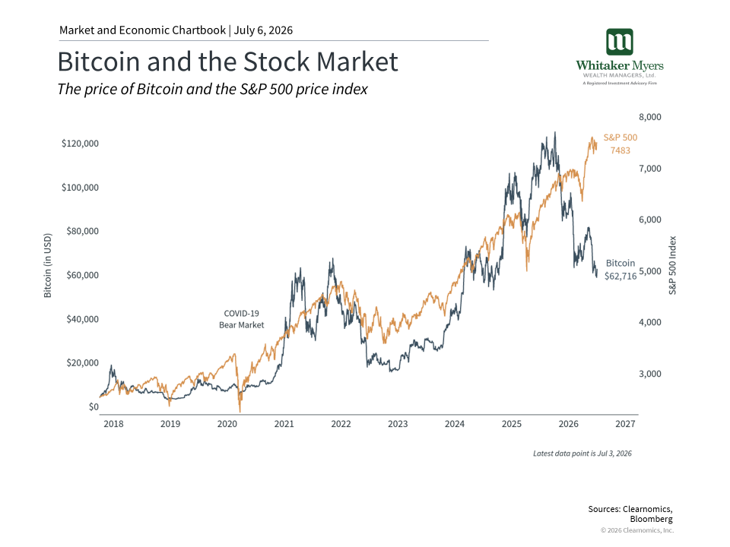
Bitcoin has not behaved like a safe-haven asset, despite being viewed by some as a dollar alternative. It tends to be highly volatile, rising when risk appetite is strong and falling during periods of uncertainty. After reaching a new all-time high of around $125,000 last October, Bitcoin has since fallen to around $60,000, even as the broader stock market has rallied, driven in part by AI-related stocks.
Price swings of 50% or more over the course of a year are not unusual for Bitcoin, as seen recently and in 2022. Like gold, Bitcoin generates no passive income and its value depends entirely on price appreciation. Unlike gold, it has a much shorter track record and remains subject to considerable uncertainty. Viewing it as one component within a broader, balanced portfolio is the most constructive approach for long-term investors.
The dollar, gold, and Bitcoin have all experienced notable swings over the past year, reflecting evolving views on economic growth, geopolitics, and monetary policy. Investors are best served by maintaining a portfolio perspective and staying focused on long-term financial goals.
References & Sources
1. Based on the DXY index as of July 3, 2026
3. From January 28, 2026 to July 3, 2026
Volatility in the Dollar, Gold, and Bitcoin: What's Behind the Moves?
July 15, 2026
Summit Puri
Whitaker-Myers Wealth Managers is an SEC-registered investment adviser firm. The information presented is for educational purposes only and intended for a broad audience. The information does not intend to make an offer or solicitation to sell or purchase any specific securities, investments, or investment strategies. Investments involve risk and are not guaranteed. Whitaker-Myers Wealth Managers reasonably believes that this marketing does not include any false or misleading statements or omissions of facts regarding services, investment, or client experience. Whitaker-Myers Wealth Managers has a reasonable belief that the content will not cause an untrue or misleading implication regarding the adviser’s services, investments, or client experiences. Please refer to the firm’s ADV Part 2A for material risks disclosures.
Past performance of specific investment advice should not be relied upon without knowledge of certain circumstances of market events, the nature and timing of the investments, and relevant constraints of the investment. Whitaker-Myers Wealth Managers has presented information in a fair and balanced manner.
Whitaker-Myers Wealth Managers is not giving tax, legal or accounting advice, consult a professional tax or legal representative if needed.
Copyright (c) 2023 Clearnomics, Inc. and Whitaker-Myers Wealth Managers, LTD. All rights reserved. The information contained herein has been obtained from sources believed to be reliable, but is not necessarily complete and its accuracy cannot be guaranteed. No representation or warranty, express or implied, is made as to the fairness, accuracy, completeness, or correctness of the information and opinions contained herein. The views and the other information provided are subject to change without notice. All reports posted on or via www.clearnomics.com or any affiliated websites, applications, or services are issued without regard to the specific investment objectives, financial situation, or particular needs of any specific recipient and are not to be construed as a solicitation or an offer to buy or sell any securities or related financial instruments. Past performance is not necessarily a guide to future results. Company fundamentals and earnings may be mentioned occasionally, but should not be construed as a recommendation to buy, sell, or hold the company's stock. Predictions, forecasts, and estimates for any and all markets should not be construed as recommendations to buy, sell, or hold any security--including mutual funds, futures contracts, and exchange traded funds, or any similar instruments. The text, images, and other materials contained or displayed in this report are proprietary to Clearnomics, Inc. and constitute valuable intellectual property. All unauthorized reproduction or other use of material from Clearnomics, Inc. shall be deemed willful infringement(s) of this copyright and other proprietary and intellectual property rights, including but not limited to, rights of privacy. Clearnomics, Inc. expressly reserves all rights in connection with its intellectual property, including without limitation the right to block the transfer of its products and services and/or to track usage thereof, through electronic tracking technology, and all other lawful means, now known or hereafter devised. Clearnomics, Inc. reserves the right, without further notice, to pursue to the fullest extent allowed by the law any and all criminal and civil remedies for the violation of its rights.


