Treasury rates have climbed to their highest levels in recent years, driven by a combination of inflation concerns, oil prices, the national debt, and Federal Reserve policy. The 10-year Treasury yield has moved back above 4.6%, and the 30-year has remained above 5% for the longest stretch since 2007.1
For long-term investors, this environment is broadly constructive, as higher yields better support portfolio objectives such as income generation and stability.
Of particular note, real yields have risen even more meaningfully. Understanding these moves matters because they shape many aspects of investing and financial planning. The difference between nominal and real yields is straightforward: a nominal yield is simply the stated interest rate on a bond, while a real yield reflects what an investor earns after adjusting for inflation. Real yields represent the true return available to savers and serve as a key benchmark against which all other asset classes are measured. Given the significance of rising real yields, there are several important considerations for investors.
Long-term real yields are near multi-year highs

The chart above illustrates how real yields have evolved over the past fifteen years. In 2020, real yields on government bonds turned negative, meaning investors were either anticipating little inflation or accepting a guaranteed erosion of purchasing power in exchange for the safety of U.S. Treasury securities. This was largely by design, as the Fed cut rates to support the economy and encourage investment in stocks, real estate, and other higher-yielding assets.
The environment shifted in 2022 when inflation spiked, prompting the Fed to raise the federal funds rate at the fastest pace in decades. Today, the 10-year nominal Treasury yield stands at roughly 4.7%, while the corresponding real yield is 2.4%, well above levels seen since the global financial crisis. Several factors are keeping yields elevated, including oil prices rising back above $90 per barrel for Brent crude amid the ongoing war in Iran and gasoline prices climbing back above $4 per gallon nationally.2
Additionally, the rising national debt and federal budget deficit continue to exert upward pressure on the “term premium,” or the extra yield investors require to hold longer-term bonds. With total national debt now above $39 trillion, greater interest payments raise borrowing costs for the government, pushing Treasury yields higher.3
Higher yields affect all parts of the market
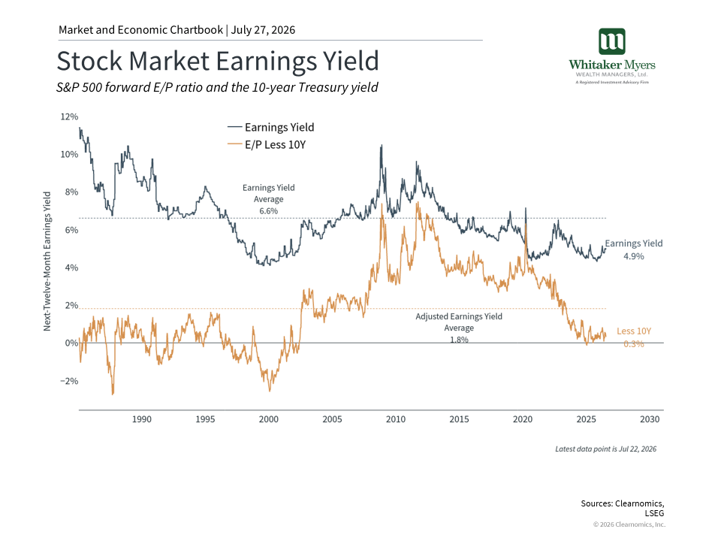
Interest rates do not only affect bonds. They also determine how attractive different asset classes are relative to one another, which is especially relevant for long-term investors managing balanced portfolios. The chart above shows the S&P 500 earnings yield, calculated as earnings-per-share divided by the price of the index. This valuation measure allows for a direct comparison between the stock market and bond yields, often referred to as the “equity risk premium.”
When real bond yields were near zero or negative, as they were for much of the post-2008 era, stocks faced little competition for investor capital. This environment was commonly referred to as TINA, or “there is no alternative.” At current levels, the 10-year real yield of 2.4% means investors can earn an attractive inflation-adjusted return from government bonds. With the S&P 500 earnings yield sitting at roughly 4.9%, corresponding to a forward price-to-earnings ratio of around 20x, evaluating the balance of stocks and bonds in a portfolio has become potentially more important than in prior years.4
The Fed balance sheet and what it means for yields
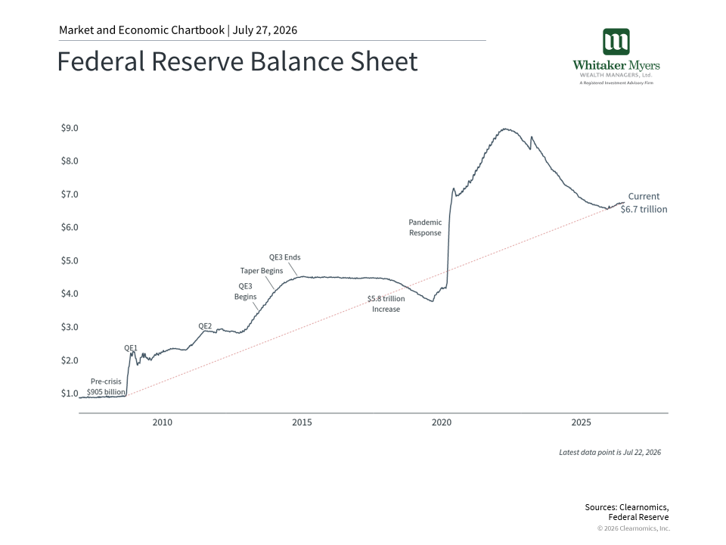
Uncertainty around Federal Reserve policy under the new leadership of Kevin Warsh adds another dimension to the yield outlook. One task force he has launched seeks to address the central bank's $6.7 trillion balance sheet. As shown in the chart above, Fed assets have expanded with each successive economic crisis, and while the balance sheet has declined in recent years as assets matured, it remains far larger than it was prior to 2008.
Warsh has long advocated for shrinking the balance sheet when the economy is healthy. This would involve selling Treasury securities and mortgage-backed securities, effectively pushing Treasury yields higher and raising borrowing costs for businesses and homebuyers. Combined with expectations of further rate increases, these actions could keep both short-term and long-term interest rates elevated for an extended period. For long-term investors, this reinforces the importance of maintaining a thoughtful allocation across stocks, bonds, and other assets aligned with their financial goals.
To “SUM-MIT” up, Real yields are at their highest levels in years, driven by inflation concerns, fiscal uncertainty, and a shrinking Fed balance sheet. A thoughtfully constructed and well-balanced portfolio aligned with financial plans is more important than ever.
References & Soureces
1. https://home.treasury.gov/policy-issues/financing-the-government/interest-rate-statistics
3. https://www.jec.senate.gov/public/index.cfm/republicans/debt-dashboard
4. Clearnomics research and LSEG data as of July 27, 2026
5. https://www.federalreserve.gov/monetarypolicy/task-forces.htm
How Elevated Real Yields Shape Investment Decisions
August 5, 2026
Summit Puri
Whitaker-Myers Wealth Managers is an SEC-registered investment adviser firm. The information presented is for educational purposes only and intended for a broad audience. The information does not intend to make an offer or solicitation to sell or purchase any specific securities, investments, or investment strategies. Investments involve risk and are not guaranteed. Whitaker-Myers Wealth Managers reasonably believes that this marketing does not include any false or misleading statements or omissions of facts regarding services, investment, or client experience. Whitaker-Myers Wealth Managers has a reasonable belief that the content will not cause an untrue or misleading implication regarding the adviser’s services, investments, or client experiences. Please refer to the firm’s ADV Part 2A for material risks disclosures.
Past performance of specific investment advice should not be relied upon without knowledge of certain circumstances of market events, the nature and timing of the investments, and relevant constraints of the investment. Whitaker-Myers Wealth Managers has presented information in a fair and balanced manner.
Whitaker-Myers Wealth Managers is not giving tax, legal or accounting advice, consult a professional tax or legal representative if needed.
Copyright (c) 2023 Clearnomics, Inc. and Whitaker-Myers Wealth Managers, LTD. All rights reserved. The information contained herein has been obtained from sources believed to be reliable, but is not necessarily complete and its accuracy cannot be guaranteed. No representation or warranty, express or implied, is made as to the fairness, accuracy, completeness, or correctness of the information and opinions contained herein. The views and the other information provided are subject to change without notice. All reports posted on or via www.clearnomics.com or any affiliated websites, applications, or services are issued without regard to the specific investment objectives, financial situation, or particular needs of any specific recipient and are not to be construed as a solicitation or an offer to buy or sell any securities or related financial instruments. Past performance is not necessarily a guide to future results. Company fundamentals and earnings may be mentioned occasionally, but should not be construed as a recommendation to buy, sell, or hold the company's stock. Predictions, forecasts, and estimates for any and all markets should not be construed as recommendations to buy, sell, or hold any security--including mutual funds, futures contracts, and exchange traded funds, or any similar instruments. The text, images, and other materials contained or displayed in this report are proprietary to Clearnomics, Inc. and constitute valuable intellectual property. All unauthorized reproduction or other use of material from Clearnomics, Inc. shall be deemed willful infringement(s) of this copyright and other proprietary and intellectual property rights, including but not limited to, rights of privacy. Clearnomics, Inc. expressly reserves all rights in connection with its intellectual property, including without limitation the right to block the transfer of its products and services and/or to track usage thereof, through electronic tracking technology, and all other lawful means, now known or hereafter devised. Clearnomics, Inc. reserves the right, without further notice, to pursue to the fullest extent allowed by the law any and all criminal and civil remedies for the violation of its rights.


